Becoming Catholic
it's been a slow process

A few weeks ago we had a group of people over for dinner including 2 women from the Bruderhof, a Hindu friend, and a Catholic priest. For some reason, and with encouragement from a glass of wine, I thought this would be a good occasion to share a re-telling of my first confession. To be clear, the confession came 10+ years after my conversion, when I was in my thirties. When I finally worked up to the nerve to show up at St. Cecilia on a Saturday morning, I approached the mahogany booth with fear and trembling. My anxiety was rooted not so much in my prepared litany of shortcomings but the reality that I had no idea how one actually goes to confession. The whole thing was a comedy of errors, including the recipient being a very young, cassocked priest who asked for too many details of all my sins when I told him it was my first time.
The eclectic table got a good laugh out of my blessed mess, now far enough in the past that it’s evolved from a sort of traumatic event to a good story. At the end of telling it I added, “I think, becoming Catholic, for me, is a long journey. I’m 17 years into my conversion and not done yet.” The priest was quick to point out that, since I take the Eucharist, I am technically converted… but I think we both knew what I meant.
I’ve never talked much about my conversion. Part of me still feels both the weight of and gratitude for the Pentecostal faith my mother gave me—a faith that formed my love of hymns, my openness to transcendence, and my devotion to Jesus. She died before I became Catholic, and I suspect I was spared a disagreement, since she doubted Catholics were truly Christians. During RCIA, Father Schutte told me that I would need to be re-baptized because my original baptism had not used the words “Father, Son, and Holy Spirit,” but the preferred Pentecostal formula, “In Jesus name.” Worrying that I was betraying my inheritance I almost stopped the process.
Because of this, and feminist concerns about the patriarchy, I went anything but headlong into my adult church of choice. Other convert friends immediately got a communion veil, gave up birth control, and became militant about the Sunday obligation. Me, not so much. Fortunately, my dabbling in my new found faith could inch along with the growth of my children. Annie was born months after I took my first (legit?) Eucharist. A one year old doesn’t know her mother is just dipping her toes in the religious tradition she’s chosen to raise her in; together we spent a lot of time in the church narthex during mass. By the time Sam took his first communion and started talking about becoming a priest, I was established enough that I could begin praying for his vocation, understanding that vocation didn’t mean job.
Looking back to 17 years ago I was nauseated with pregnancy when, at the Easter vigil at St. Joseph’s parish, I renounced Satan and all his ways and embraced with reticence the Holy Catholic Church. I’ll admit I converted for my future children mostly and, at a deeper level, for my marriage. My husband Ben was a cradle Catholic, his parents daily mass attenders and retreat leaders with stacks of prayer books and rosaries, but he would say, “I feel kind of lukewarm about it all.” I didn’t feel lukewarm about Christianity so it presented an early issue, rippling into our courtship with break ups and reasoned pleas for unequivocal commitment.
When I married into his family, the anthropologist in me quietly observed what held them together. If we were going to raise children and anchor this marriage in Christ, the surest foundation would be the sturdy, devotional Catholic faith of my in-laws. In this faith, my daughter would delight in a first communion dress that looked like a wedding gown and be enveloped by great aunts who were nuns and missionaries. Rites of passage would bring cards and cash and heartfelt letters from their grandmother who was so pleased to see each of these milestones achieved. All parties would agree that faith was the center of our life, with Catholicism as more like a brand.
It surprised me, then, when I actually started to become a Catholic.
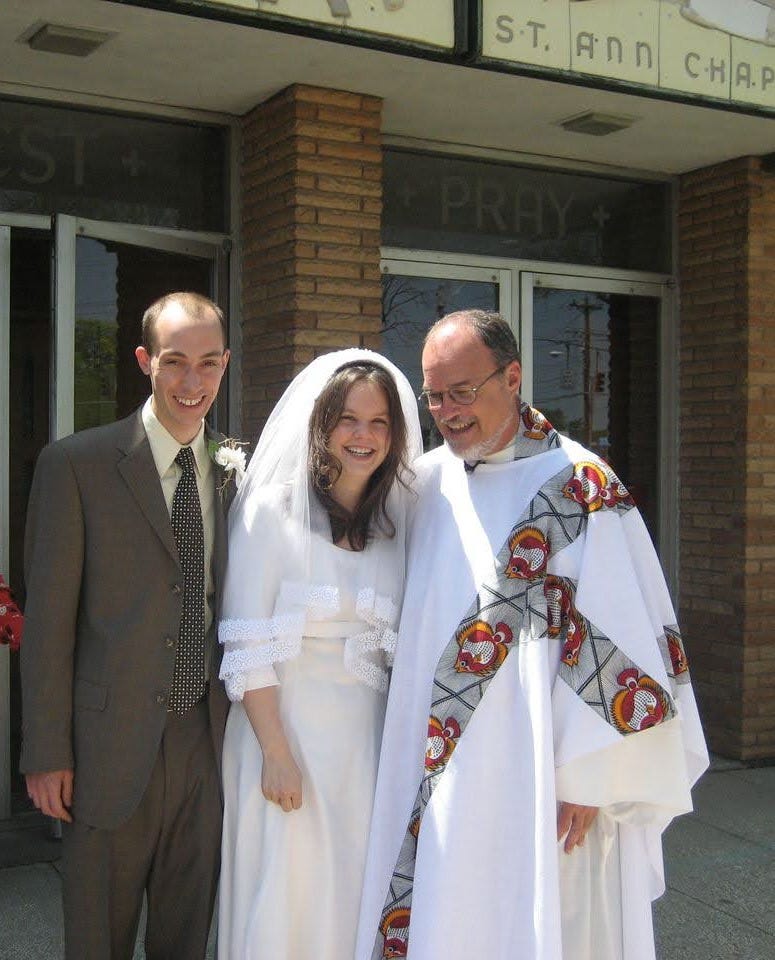
I’m not sure when or how it happened. Perhaps it was informed by my long intellectual and spiritual relationship with Dorothy Day, the Catholic Worker foundress, herself a convert and orthodox in practice. Perhaps it was the realization that in any city, any where in the world, I had a home in the Church. I think it was strengthened by the practice of the Church to have open buildings during the day, which led me to its kneelers and candle lit saints. It was certainly helped along through the faith of my son, his prayer beads and daily Bible reading. And, as I’ve written, it was reinforced by the sheer availability of, and my growing fascination with, the daily mass. I keep going back to ponder the transubstantiation of the Eucharist, and wonder if Christ made real in bread and wine might somehow interact with my broken mortal corpus.
This past year, it’s been a salve to me to take advantage of the uniquely Catholic parts of being sick. Before I went in to have part of my breast removed I, with some reticence, asked my priest friend to perform last rites. I knew I wasn’t dying, but that’s the only word I had for what I wanted. He gently informed me it’s now called anointing of the sick, and we all were going to believe this wouldn’t be the last occasion I’d receive it. He brought the oils my house. Ben and the kids were there, and Meridith and Wanda. It was intimate and transcendent, but also stubbornly embodied. The sacramental paradox unfolded on our back patio with the neighbor’s dog barking over the fence, the eternal lightly breaking into linear time.
Last week I prayed my inaugural rosary. I’ve been gifted approximately a dozen since my conversion, but like with confession, I had no idea what to do with them. Meridith and I watched videos and read tutorials, and were joined in this prayer by Jane, a legit lifelong Catholic and Erin, the Catholic of the Catholics on our staff. We felt confident we could see it through, and we did, even as I stepped in and out of the adjacent kitchen to stir soup. We prayed it as part of a Novena, a word I only recently came to understand meant “nine,” for nine rounds of prayer. We dropped in the Fatima prayer, amused with it’s opening exclamation, “Oh my Jesus!” All of these things I associate with real Catholics, which I have to admit I am now.
A lot of people ask me about my choice to voluntarily join this fraught institution as an adult; they bring up it’s strangeness and brokenness. “Is the Pope really able to pronounce infallible truths?” “What about the scandals?” They ask me because they respect me, and (I think) because I’m the only practicing Christian they know. My answer is that the Catholic Church is the train I’m on, the clunky vehicle I’ve chosen to move through this life in communion with the people of God, in hopes that I might be worthy of the next. It’s created space for me to pray in gratitude and petition, and held Lydia’s House from birth to maturity, offering time, talent and treasure. It’s the way I am a disciple; not the only way to be one, but the way that works for me. It’s beautiful, gangly and complicated; it continues to surprise and delight me. I have no regrets.
Should my cancer progress to something awful, like my bones, it’s this Church that will set the schedule for priests to visit me in the hospital, give me actual last rites, and structure my funeral so that it’s consequential and comforts my husband and children. I know what the funeral of a youngish mother looks like— it’s kind of a tragic mess. I take solace knowing that, for me and mine, the scaffolding of this rite are already in place. Meridith doesn’t have to try to write up an order of service through her grief, there will be no “celebration of life” at a bar, the music will not be recorded but rather played on real instruments because the Church hires musicians. People will have a chance to really mourn and wear black and read from the Bible. Because my children have been in this Church most Sundays of their life, they will then have a structure to pray for the repose of my my soul, a way to ask for mass to be offered in my honor on my birthday or death-day, and a story filled with hope of what happened to me even though, physically, I’m gone from this world.
I didn’t become Catholic for this hard season of life but, kind of, I did. I believe in Church as a way to give shape to life in good times and bad. I wanted to raise my kids in this Way, so they would come to know Jesus and get a glimpse of the best in people. I became Catholic because I believe in institutions and wanted to root my life in one. When I took my vows of marriage I told Ben, “In sickness and health. All the days of my life.” The Catholic Church, to some extent, promised that to me too. It’s been there for me through my marriage ceremony, the baptisms, the first communions, funerals, fundraisers, fish frys. It’s educated my children and provided mattresses for our shelter guests. It offers its broken, mangled body for the life of the world, and for my life in particular. In return, to the best extent I can, I’m offering it the same.


And the update…
I started the follow up med to my ovary suppression shot. It’s supposed to strip more estrogen from my body. I’m nervous about it, because estrogen is not something you really want to strip from a woman’s body. Please pray for me as I add in this new variable.
Also, join us this Friday at The Church of the Resurrection for a Fish Fry (4-7pm) and/or next Tuesday and Wednesday for day 5 and 6 of the Novena. Lots of opportunities to be Catholic around here.
I have an almost opposite journey. Though not catholic I grew up Episcopalian, baptized as an infant, and confirmed at 12. My family went to church together when I was young, but as I grew older it was often just my dad and me. I always loved the liturgy though Episcopal hymns are very difficult to sing! When I met Dane, a Baptist who is not a fan of the liturgy, we opted to find a compromise and joined a Methodist Church. We became very involved and I began to learn a bit more about what it meant to have a relationship with Jesus. When Dane felt the call to ministry he decided that the structure of moving pastors in the Methodist church did not work for him and decided on Southern Seminary in Louisville. At that time the denomination was in good shape before the push to the right. We both ended up getting seminary degrees and had a great experience there. Our first church was a small county seat church that had employed a lot of seminary professors and students over the years. Dane decided to get his doctorate at the same time his parents moved to AZ for health reasons, so after about 3 1/2 years we moved to Tucson. Dane enrolled at the University of Arizona and pastored a small church 20 miles outside the city for $50 per week while I taught public school. Again the church was very ecumenical for a Baptist church and we ended up staying there for 31 years. Dane taught adjunct for Fuller Seminary and Golden Gate for a while. I loved the worship gatherings for Fuller because students from all forms of Christianity were there. The ecumenical perspective was amazing. Everyone shared the supper together.
When we moved to Cincinnati we found a more nondenominational church with a tad of liturgy and a tad of free church mixed together.
All of these experiences have shaped my faith. I still love a variety of experiences and listening to how the Holy Spirit reveals more and more about God and Jesus in so many different people, places, and ways.
I didn't know these aspects of your background and I'm grateful to know about the journey - I related to much of what you said, especially the bit about Catholicism being a clunky train we've chosen to carry us through this life and maybe on to the next.
"The sacramental paradox unfolded on our back patio with the neighbor’s dog barking over the fence, the eternal lightly breaking into linear time." <-- also this line slayed me; never stop writing